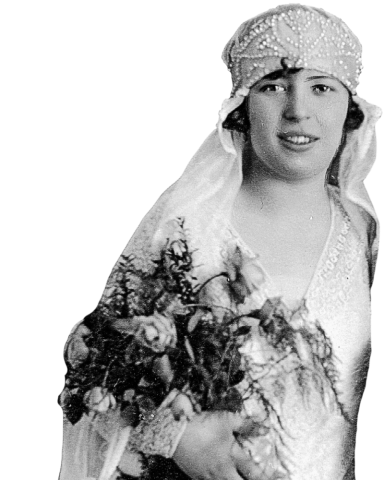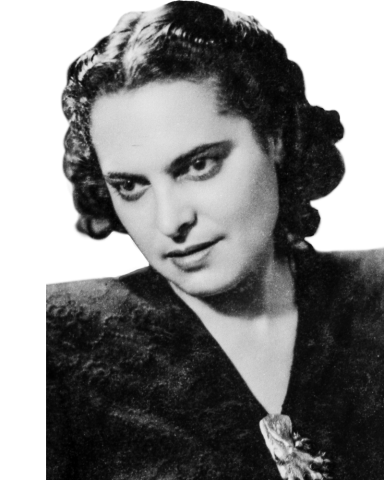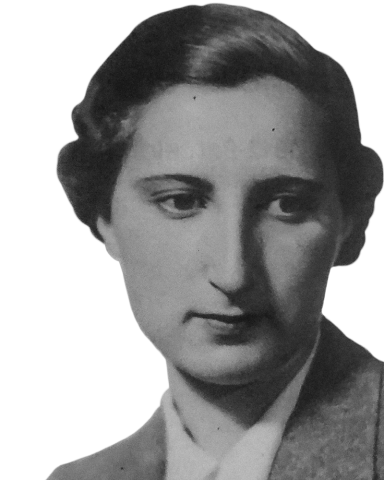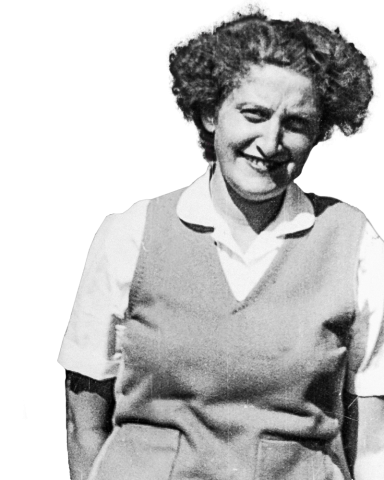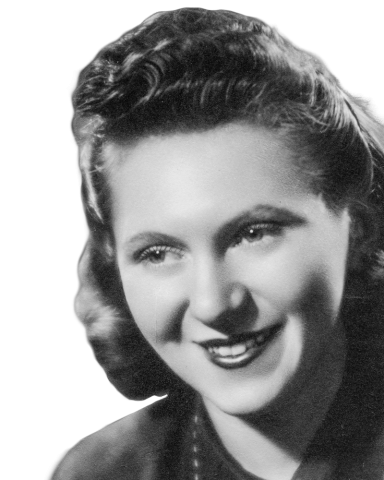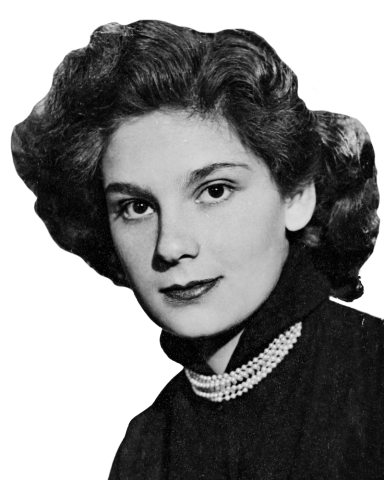
Vera Szekeres-Varsa
Vera Szekeres-Varsa was born in 1933 in Budapest, the second child to a long-ago assimilated Jewish family with no religious beliefs and vivid Hungarian sentiments. In 1944, when the Germans marched in Vera's life changed drastically.
Interviewed by
Mihály Andor
Year of interview
2007
Interview location
Budapest, Hungary
Vera Szekeres-Varsa, Budapest, Hungary
Interviewer: Mihály Andor
Date of the interview: February 2007
Translation: Antonia Szenthe
Vera Szekeres-Varsa, a language teacher, is still active as head of a university department. She lives in Budapest, in the neat Lipótváros district, surrounded by noble and beautiful objects. Vera is an excellent, collaborative interviewee who is strongly motivated to preserve the memory of her family and especially of some of her beloved family members. She does not show her age, dresses youthfully, and her stature, posture, and movements are more that of a woman in her forties than of a 74-year-old.
*
One of my maternal great-grandfathers, Ármin Weisz, was a wholesale dealer in agricultural products in Komárom (Komárno)
One of the five children, Ernő, came to Pest, changed his name to the more Hungarian-sounding Vadász, and became a banker. They were well-to-do; he and his wife went on holiday to Abbázia (Opatija),
The other child, Blanka, married Béla Leveleki, a Jewish forester, lumberyard owner, and wholesale dealer from Transylvania. They had a large apartment in Marosvásárhely (Târgu Mures) and a summer house in Szováta (Sovata). Aunt Blanka was so much of a Hungarian that when Transylvania was reannexed to Hungary,
The third child, Oszkár, did not get a noble upbringing; he befriended the coachman of the household. He was a printer and died quite young, in the 20’s. His wife was a seamstress. His son, Ferenc Vadász, joined the Communist movement in Czechoslovakia and became a worker-correspondent for a Hungarian-language, crypto-Communist, or at least strongly left-wing newspaper called Magyar Nap (Hungarian Day). Later he became a journalist. As a young Communist worker, he got into Hungary, where he was arrested and sent to Kistarcsa.
The fourth child was Aunt Mariska, also uneducated, and she preferred to befriend the servants. Aunt Mariska married the Jewish railwayman József Gombos, later stationmaster of Baja. Aunt Mariska was like a grandmother to me because none of my grandmothers were alive when I was born, and Aunt Mariska came from Baja when my sister and I were born. I remember her as a very nice, curvy lady wearing a pretty white apron. Her arrival at Auschwitz and her husband's Uncle Jóska's arrival are recorded. They were already old people then. They had two daughters, but they survived the war. One lived to be a hundred and three, the other a hundred and four. And both remained in good mental health. A strange compensation for the good Aunt and Uncle.
The husband of one of the girls was a Croatian Christian man who hid her. He also wanted to hide his sister-in-law and her family. Still, the brother-in-law said it was impossible, and they fled to Italy. From there, they made an adventurous journey to Switzerland, where three of the family of four survived. The sole victim of the war was not murdered, either, "only" killed by wartime conditions: his diabetes could not be treated properly. Of course, they were hardly allowed into Switzerland. My aunt told me they were standing at the border, a small group with a few children, and they didn't want to let them into the country. They all spoke German. The Swiss border guard officer told them to wait, to move a little, so they wouldn't be so visible. They heard him on the phone saying that he would resign and disarm if he had to deport them back with the children. After the phone conversation, he told them to wait until nightfall, and they were let in in the dark.
The fifth child, Gizella, my grandmother, was born in Komárom, in 1871 and died in 1921, in Törökbecse (Novi Bečej). My grandmother was raised as a lady, and as a child, she had a mademoiselle at home. In 1890 she married Izsó Garai, who lived from 1859 to 1937. His Hungarian-sounding name was changed from Grünhut. I do not know how they met, but I have a suspicion. Ármin Weisz was said to be a Freemason; I don't know if he was a member of the Komárom, the Bratislava, or possibly the Vienna Lodge. But I know that Izsó Garai was a member of the Lodge in Szeged. I assume that when he lived in Körmend, he must have visited the Lodge in Komárom, which was in the vicinity, and that is where the connection comes from.
All I know about the Garai branch is that my grandfather Izsó's father was Miksa Grünhut, and his mother was Erzsébet Mauthner. When they were born and when they died, I don't know. Miksa Garai was a steward or estate manager on the estate of a distant relative in Körmend or near Körmend.
They had two children, both born in Törökbecse. The first was my mother, Ilona (1892-1972), and the second was my uncle, Laci. Uncle Laci was born in 1893, graduated from high school in Szeged, then from KERAK,
My mother remembered her childhood as a happy, heavenly time. She called her parents Mummy and Daddy. There was already a bathroom in the house in Törökbecse, but there was no running water. So, water had to be fetched from the well; a yardman regularly filled the tank. The sewage ran to a cesspool. It was just like running water for those who took a bath but not for those who carried it. The toilet worked the same way; someone filled the tank continuously. There was an ice pit in the yard as well, called ‘katráka’. The farming area also had a sort of rack. And there was a rose garden. No farm animals were kept.
The furniture that I remember in the bedroom of our Pancsova home came from Törökbecse. As a child, I remember a huge painting I saw in Pancsova, which I can still describe. I know it came from Komárom, from the Weisz's, probably as dowry; my mother said it was from the seventeenth century. Later, when I became an art historian, I realized that if it was really from the seventeenth century, it must have been a Snyders,
The house in Törökbecse had five rooms; my grandfather had some sort of office there. There was a parlor with a piano and separate rooms for children of different sexes. A Fräulein lived with them; my grandfather held that the children must learn Hochdeutsch
They were very social. At least twice a week, they received guests at my grandmother's house. On other days they visited other people's houses. So, there was something happening almost every day. The gentlemen might not join each time but the ladies and children did. Just as an example, my mother's piano teacher was an Italian woman, Piccola, she came with a local gentleman to Törökbecse. And there was a tennis court; they used to play tennis.
These grandparents were not religious either, neither they were vehemently anti-religious. My mother went to a public elementary school for six years. The school was across the street, and it was the yardman's wintertime task to sweep the snow so Iluska could pass easily. When the road was muddy, he would lay planks across the puddles. By then, Iluska spoke good German and started to learn French from her mother. She had lots of toys, and a dog who was dressed in doll clothes they sewed.
When my mother was twelve, she started boarding school at the Public High School for Girls in Temesvár (Timisoara). It was a four-year school for girls, till the age of sixteen. They slept in dormitories of sixteen beds; one of the girls was a baroness of some sort. My mother arrived by the family's horse-driven cart. It was definitely a school for fine misses. For example, they learned to burn patterns in velvet. I still have my mother's pattern book, and I have the velvet case of the burning needle as well. And then, they learned housekeeping; how to instruct the cook, who obviously knew better how to do things. They learned literature, German, French, and music. Italian was also a choice; my mother enrolled. Once a week, they had a day off and could go out to the city. The college had a policy that children had to bring their own cutlery. They had to carry silver cutlery, and they had to engrave their initials and their dormitory number on it. I have a spoon with GI 48 engraved on it. The report card indicated that she was an Israelite, but I never heard anything about visiting a synagogue. Nor did she tell me of any conflict with her peers over her denomination. She liked it there a lot. They only went home during the school holidays. In addition, on Sunday afternoons, parents were allowed to visit. By then, my mother knew with certainty that she wanted to be a doctor. She was planning to take an exam as her school did not earn her the high school certificate required to enroll in university. She would have had to catch up mainly in Latin, which she agreed to without further ado. She would have had to go to a gymnasium in Szeged to take the exam and she could only stay if she could live with someone trustworthy there. But there were no relatives in Szeged. Back then, high school teachers used to take in boarders. But they couldn't find such a family with only daughters and my grandmother declared that she would never allow her to stay at a family with a boy. That was the end of my mother's education.
She did not rebel, but she tried to do something about it. She told me that the hardest time was when school started in the autumn for others. She was determined to learn all of Schiller's dramas by heart in German. She never got that far, of course, but she knew a lot, not just dramas. She told me how she studied in the garden; as the Sun sank, it was getting cooler but she did not stop reading. To catch the light, she followed the rays of the Sun. But she also studied Goethe, played the piano, and educated herself. She had a great appetite for culture.
After my mother came home to Törökbecse at the age of sixteen, she played tennis and entered the party life. Young men came to the house, played the violin, and she played the piano. They had scenes-of-life pictures taken, they dressed up as one thing or the other and let official photographers take the shot. My grandmother had already started to make sure that there were suitors. My mother was very rebellious, yet she had no conflicts with her parents. She probably believed they meant the best for her. But her rebellion manifested in turning down all the suitors. When she was twenty, she had already turned down the tenth suitor, Vilmos Engel. My grandmother sat down with her in the drawing room and told her: “My dear, what do you want to do with your life? Do you want to end up as an assistant pharmacist?" And then she realized that maybe that wasn't a perspective, and she said yes to Vilmos.
Vilmos Engel came into the family through Freemasonry. My grandfather [Izsó Garai] was a Freemason, a lodge member in Szeged. They told me that in 1912, he came home from a lodge meeting in Törökbecse and told his wife Gizus that there was a new member in the lodge, a sympathetic young man, and he would invite him. And they agreed to invite the young man, whose father, Dr. Mór Engel, a lawyer, was a founding member and also an officer of some sort in the Szeged lodge, one of the recommenders of Ferenc Móra. So, they invited Vilmos Engel, who, I imagine, saw my mother and fell in love with her at first sight. And I not only imagine, I know that this love lasted until death. We somehow inherited this love in a sublimated form because he showed unconditional, devoted love for me and then for my daughter.
Vilmos Engel was a journalist and co-owner of the newspaper Szegedi Napló (Szeged Journal).
When they got married in 1913, the journalists of the newspaper published the first and last issue of a "nuptial magazine" called Előleg (Advance), in which István Tömörkény, Ede Kisteleki, and István Ortutay, among others, wrote funny articles.
After the wedding they were on honeymoon in Venice for six weeks. My mother tried to brush up her Italian while everyone around her spoke German. She had a good sense of language. After the honeymoon, they moved into a large apartment. Izsó Garai ordered the furniture for seven thousand four hundred crowns. According to the invoice, the order consisted of “Dining room (dark oak, with copper embossing): 1 credenza, 1 cupboard, 1 patent table, 8 chairs, 2 armchairs, 3 curtains, 1 tablecloth, 3 bonne femme,
The house belonged to Szegedi Napló; the publishing office was there, the printing house was in a side wing of the building, and the apartment was on the first floor. Besides the salon, there were two or three other rooms. The salon was so large that occasionally it served as an exhibition room for the Szegedi Napló artists.
I have a letter from my grandmother from the end of 1913, which she wrote to my mother from Törökbecse, advising her who to visit and when. If possible, she writes, don't postpone your visit to the X's, else it will be cold to wear the outfit that is best for the occasion, the best to wear at the X's. The newlyweds had their own two-horse carriage. My mother already exercised at home and was a keen member of the Szeged Athletics Club, where she enjoyed rowing.
Uncle Vilmos was a lieutenant during the war. He got typhoid fever on the front, survived, and then got through the war relatively easily. When they married, Izsó Garai gave his daughter a monthly allowance of three hundred golden crowns. During the war, my grandfather and Uncle Vilmos purchased war bonds,
Since the Szegedi Napló was notoriously Jewish-owned and left-wing, Uncle Vilmos was in danger in 1919. He did not even live at home for a few days. Somehow the Szegedi Napló also got out of his hands, and he became an employee at the Athenaeum Printing House, first in Szeged, then, for a short time in Pest.
My mother traveled with her mattresses because she said the beds in Italy were not good enough. She declared that she had to look modern in Rome, so she cut her hair. But she kept a piece of it so she wouldn't go with such unimpressive hair if she had to go to the opera. Then she would pin on her own supplementary hair. They traveled with incredible luggage, but after six months, they came home because my mother couldn't take it. It was my father. Her love for my father started before they went to Italy. He lived with Uncle Vilmos in Szeged for maybe another year after that, and then my mother moved to Pest in 1927. Uncle Vilmos later sold his interests in Szeged; he also moved to Pest where he had a small printing press. They were always good friends; even my father was good friends with him.
My mother, now Mrs. Engel (Engel Vilmosné), lived in Pest, in the Fifth District, in Pannónia Street. My father already lived in Pest when she moved up. My mother opened a lingerie shop in her apartment. She had a Singer sewing machine. A lady must have had a sewing machine at home because every week or so, a seamstress came to the fine households to cuff, hem, take in or let out, sew the fallen buttons, etc. In Temesvár, sewing was part of the curriculum but not tailoring, so she never could obtain a license. But she did meet a tailor, a brilliant, well-educated Jewish woman, Manci Hillinger, with whom she remained excellent friends until her death. She tailored, and my mother sewed. Mother made notes printed to the ladies of Szeged, saying, "If you come to Pest, I will be glad to be at your service."
Meanwhile, in 1928, my sister Klárika was born. They were not yet married, but she was already called Klára Varsa. At least, I think so. They married in 1932. I don't have my mother's letter to her father and brother before she remarried, but I have the reply. It says: “Come home with the baby; we can support you in Szeged. But we are not able to support you in Pest.” Apparently, they accepted the situation. My grandmother was no longer alive, having died in 1921.
After the death of my grandmother, Gizella Weisz, my grandfather and Uncle Laci moved to Pancsova (Pancevo)
Before I go on with the story of my parent's life together, I'll share what I know about my paternal side. My grandfather's father was Ferenc Weisz, and his wife was Erzsébet Lechner. I don't know when they were born or died, but I know that the myth of the family's Kuruc traditions
My other great-grandfather was Áron Kesztenbaum. The family legend says that his wife, Erzsébet Molnár, was a Unitarian Christian who converted to Judaism. I don't know much about them, but perhaps the newspaper article in the 14 December 1935 issue of the newspaper Egyenlőség (Equality) about Áron Kesztenbaum's brother or uncle tells us something about the family:
"Kesztenbaum, the Singular Man from Zemplén
In Sátoraljaújhely, the Jewish school of Kesztenbaum, nearly a century old, has deservedly risen to fame. It was established by the county authorities based on the will of the generous Jewish philanthropist from 1825. Kesztenbaum bequeathed 100,000 Forints to erect a suitable school in the synagogue courtyard in Sátoraljaújhely, Zemplén County. The noble Mr. Kesztenbaum wished to offer proper education for the area's Jewish youth and dispensed free tuition to the orphans of his brethren…
The testator, Márton Rafael Kesztenbaum, was a simple man. In his lifetime, no one would have guessed how noble-minded he was. He wore peasant clothes and was known to be thrifty if not avaricious. Rumor has it, on the county meeting days, he went to Sátoraljaújhely from Pelejte, where he was a landowner,
Kesztenbaum had no education, little friendship with reading and writing, and his knowledge of Hebrew was limited to reading and writing. Still, he was friends with almost all the respectable men of Zemplén County. ...
In 1825, with the foreboding of his imminent death, Kesztenbaum prepared his last will and testament, in which he was forever inscribed in the history of Hungarian Jewish philanthropy. The will was deposited in the County Archives. However, it was not until 28 November 1829 that Kesztenbaum closed his eyes in the arms of his friend and lawyer, Mihály Resko. ...
At that time, the Jews of Zemplén could hardly understand the idea of founding a school, and the execution of the will and finally the opening of the school can only be attributed to the officials of the county."
Farkas Weisz was considered a rebel in the family. He should have enlisted as a soldier in 1865, but instead went to work illegally among the fishermen of the Tisza and only emerged after the Compromise.
They had eight children but only four made it to adulthood: a daughter and three sons. The three sons changed their names to the more Hungarian-sounding Varsa sometime in the early twentieth century, between 1905 and 1910. I don't have the document about hungarazing
The younger son, [Gajdos] Sándor, was also very talented but not hard-working. He preferred horse races to studying, played cards, and had had bourgeois whims. When he was sent to university in Vienna, he bought two beautiful greyhounds instead of taking the exams. Eventually, he became a lawyer and lived a somewhat frivolous, bohemian life in Pest. After the war, he became a merchant for export-import. He divorced his first wife. His son from that marriage worked in foreign trade as a mechanical engineer. Sándor died in 1986 in Düsseldorf, where he had defected with his second wife, in 1957. He somehow managed to make it legal. I remember him telling me that when he was a captive as a forced laborer, he caught a moment alone with a guard escorting him from one place to the other, and said to him: “Look, I have nothing, I can't give you anything, but the Russians are already here. If you let me go now, and then you come to me after the liberation, I will reward you handsomely." He was let go, survived, and the guard came to claim his reward after liberation.
After Róza, the eldest son, Varsa (Weisz) Imre was born in 1873, so he was nineteen years older than my father. When he finished elementary school, the teacher visited them and said, "My dear brother Farkas, the child Imre needs a chance at further schooling." And then they put him in a public school, and he became a printer, a proofreader. He took part in the First World War, was at the siege of Przemyśl, and was taken prisoner. He wrote about it, and some of his books were published. (The family had some literary talent; my father also wrote poems. Bad poems, but they were still poems. He might have written good novellas.) His wife was Aunt Zsófi, and they had three daughters, Klári, Magda, and Erzsébet. They lived with the quality of life of the lower-middle-class; I think they had a three-room flat in Józsefváros until the girls married. As I remember, the flat was dark, and the doors were dark as well. Their eldest daughter, Elizabeth [Varsa], was born in 1899 and died in the early 1990’s. She was a beautiful girl, married twice. The first husband was at least twenty years older than her and was a senior official at the Hungarian State Coal Mines.
A few years later, the teacher returned to the Weisz’s and said, "My dear Farkas, the Dezső child, he has to be educated, too." And so, Dezső finished KERAK after public school, a two-year trade school, a kind of vocational school.
Uncle Dezső married a Christian woman, Erzsébet Bogdánffy of Bogdánfi. My religious grandmother was devastated and made my father, who was still unmarried at the time, swear never to marry a Christian woman. My father swore. Uncle Dezső converted before the wedding and gave a reversalis vow, but the grandmother did not know about this.
Both my cousins [Ferenc Varsa and István Varsa] were engineers. During the '56 revolution, István was in Moscow on an official business trip. When he returned, he defected at the end of the year. He didn't dare taking his two sons and wife with him, and the family followed him in a very adventurous and strange way years later. They ended up in America, divorced there, and István remarried. He married the widow of Colonel Koszorús, who has a marble plaque dedicated to him opposite the Dohány Street Synagogue.
For 13 years, the Weisz couple took a long break, but then my father was bor. When my father finished elementary school, the same teacher came to my grandfather again and said, "The Jóska child really needs further schooling." But then my grandfather, who was already in his sixties, said it was impossible. He couldn't have him educated. My father's younger brother, Dezső, thirteen years older, who was already a married bank official in Kikinda, took him in and had him educated. They must have lived in a big flat because when he arrived as a little boy, the couple already had two small children. Still, he had a separate room.
He didn't tell me much about his high school years. He didn't like going to school; he didn't like Latin or German. Only Hungarian and history. And athletics. There were athletics clubs in Nagykikinda. In 1911 he graduated from the Public High School in Nagykikinda and wanted to go to university, but my uncle couldn't afford to do it. He knew that his uncle had to educate his own two sons, as well. So, my father, who wanted to be a Hungarian literature and history teacher, became a law student in Budapest, at the Pázmány University.
In 1915 he was shot in the lungs on the Eastern Front and was hospitalized. He recovered too soon, thanks to his strong, athletic body, and was sent back to the front. He spent six weeks in the trenches, where everyone had a cold or flu, and he caught TB. Then he was taken prisoner of war
After the October Revolution
When my father arrived home in 1918,
So, my father came up to Pest in the late 1920’s and opened a law office in Aunt Róza's apartment on Rákóczi Road. He lived there, and there was room, as the boys were no longer at home. A cousin, Mariska Kesztenbaum, was the secretary. She died four or five years ago; I kept in touch with her. She was the only one of my paternal grandmother's family I had contact with. She was the daughter of Erzsébet Kesztenbaum's brother.
As I said, my mother came up, and my sister was born in 1928. They married in 1932 and established a home together. They lived at 14 Pannónia Street briefly, then moved to Alag,
My father's office stayed in the Gajdos' apartment on Rákóczi Street until 1936-37, then it moved to Uncle Dezső's apartment on Hold Street,
I was three and a half years old when my sister died in September 1936. By then, she had been bedridden for a year and was never a real playmate. Anyway, there was a period when I was ill and in hospital. I had tuberculosis and, at the same time, whooping cough. The doctors didn't give a penny for my life. They told my mother to take good care of her older child. They thought she had a better chance of surviving. I don't remember much about my sister. In the photographs, until she was three or four years old and became ill, she looks like a little blushing, cheerful child. Then there comes a period when she seems very sad. She started school at Alag local elementary school. My mum and dad thought she had gotten sick because she had been vaccinated in school, even though the family pediatrician had vaccinated her earlier. They questioned why they had not been asked about it. My sister finished the first class, and then her school career ended.
My father became temporarily religious for about three years after my sister died. Before that, he was not a believer at all, so much so that when I was in my first year of elementary school and I heard that we had to light candles on Friday nights, I took out a glass tray from my mother's room, took two candles from the pantry that we had saved in case of a power cut, and lit them. My parents scolded me; my mother said the glass tray would crack, and my father said this was a pagan thing to do. That was my religious upbringing. My sister's death was even worse than expected because she got tuberculosis from my father, who interpreted it as murdering his child. I learned from my cousin Alfred a few decades later that they feared he would have a breakdown or commit suicide. He could not do that because I was three years old. I think his sudden religiousness was a psychological solution to all this. The family was so irreligious that when they wanted me to pray in the evenings in memory of Klárika, no one knew a prayer either in Hungarian or Hebrew. Then after three years, religion somehow dissipated from my father, parallel to the growing influence of Nazism in Hungary. (Hot-tempered poems bear witness to his feelings.)
Then, religion came back once again. In 1948, my father was in the hospital, obviously knowing that he didn’t have much of his life left, and suddenly he asked for a rabbi because he wanted to return to the Jewish faith.
My earliest memory is when we moved into the Phoenix House. Huge people carried a huge wardrobe, and my mother told them where to put it. To keep me calm, I was given a bag of honey candy. Otherwise, they were meticulous about when, what, and how much I ate. And every time I reached into the bag, I got a broken piece, even though I could see there were whole pieces. I was two and a half years old.
The apartment in the Phoenix House had a bedroom, dining room, salon, hall, maid's room, kitchen, bathroom, toilet, and pantry. Hot water all day round, central heating, a spacious garden in the courtyard, divided into four sections. Every spring, four big flower beds, and tulips of different colors were planted in them. In the middle stood a fountain with a female figure, a big statue. During the siege, her head was knocked off on the pedestal by an impact, and it always served well as a swing. I think the house was built in 1931, and my mother was very proud of her modern apartment. The apartment was furnished with furniture from Szeged, some of the carpets were so big that they didn't fit, so they were rolled up.
I don't know what cases my father's law firm dealt with. The Kecskemét Canning Factory must have been his client because we received many canned apricots. They were delicious. I once overheard my mother and father talking about somebody wanting to entrust him with something. My dad offensively said he wouldn't take it, "You don't think I'm going to take a case where the client is wrong!" Then I am aware of one more case of his for sure. Near Balatonalmádi there was a settlement called Budatava where a development sold plots. They were sold at a down-payment of half the price, and then in installments over two years. My father was the lawyer for this transaction, and instead of a fee, he asked for a plot of land at half price. He got it. We didn't use it for anything because my father was ill, and after 1945 it was expropriated. After a long litigation process, my mother somehow got it back in 1954. Of course, by then, someone had already built a house on it, so we got another one. The village was no longer Budatava but Almádi; it had public utilities. So, he was dealing with civil cases like that, not with criminal cases. Maybe even divorce cases.
In the meantime, my mother was mainly a housewife because my father and sister were ill. That alone made life very difficult. She was always trying to do something about it. A certain Aunt Manci, with whom she ran the lingerie shop for a while, worked as an employee in someone's fashion salon on Katona József Street. Sometimes, when there was too much work, Mama would get some to do at home. She sewed beautifully. But she sewed very little and earned very little.
I started school in 1939, a private school. They didn't want to send me to a private school, and my mother told me very proudly and self-consciously that she was sent to the public school for girls. But when my sister died, and no one in the family was sane, I was taken to Kozma Street Cemetery for the funeral. It was a traumatic experience. The first was that all the ladies had black veils in front of their faces. The second was seeing my father's shoulders shaking with sobs. I started to cry loudly. A maid, a country girl with common sense, lifted me up, took me in her arms, and carried me away. And then I saw right into the pit just as she took me in her arms. I understood that that's where they'd put my sister. I was terrified. I cried uncontrollably for a long time, and then I stopped talking. By then, I was babbling a lot, reciting long rhymes by heart. I was a very talkative little kid. I was already being taught German by my mother, who was very attentive to my Hungarian. When I was three, she decided it was good enough to start German, and she started teaching me. So, after my sister died, I stopped talking. I talked to my parents, the maid who lived with us, and the children I met in the park, but I didn’t speak to adults. Not Uncle Dezső, not Uncle Vilmos, no one. Until then, I chatted with each of them easily. My family was frightened. They called a psychologist and a doctor and tried to work it out. I heard what they spoke about me – children are always aware of talks about them – so, I hid under some furniture when someone came to examine me. They only could get me out by force, and they didn't want that. When the doctor left, I would come out and go on playing with my dolls and teddy bears. So, they couldn't send me to a public school because you can't send a mute child there. This is why I went to a private school on Pozsonyi Road, Erzsébet Répánszky's private school, where there were four of us in a class. It was actually a four-grade, undivided elementary school. There was a pretty big room. All four classes were there. In some classes, there were only two or three kids. We had to go to the other room during music class because that's where the piano was. We didn't have gymnastics, but we went for walks every day, the whole school, all twelve kids. Miss Erzsi also had a helper, Miss Sári, who taught English. When I think back, I think eighty percent of the children were Jewish.
At home, I was always with my mum. She minded me, we played, we talked, she recited many poems to me. Early on, she read to me from the book "The Adventures of Muki and Bubu from the Jungle to the Garage" by Mózes Gaál.
Nonetheless, my father played some role in my upbringing as well. He once told me that he really wanted me to learn a poem. This must have been in 1942, when he learned that he would certainly not be able to raise me. It didn’t matter if I didn’t understand, he'd try to explain it and I should try to remember it. Every day I would learn a passage and tell him. I could tell he was happy. It was "The Old Gypsy" [by Mihály Vörösmarty]. But he also made a serious pedagogical mistake. Once, when he heard my mother speaking to me in German, he asked her why she was teaching the child German and not English or French. My mother knew French quite well, and she knew some English, but far from the native speaker level at which she spoke German. The next time my mother spoke to me in German, I said I didn't want to learn German, I wanted to learn English. My German lessons stopped and of course the other language did not come too much, either.
My father was a great influence on me. If he said something, I took it very seriously. But the occasion was rare, because he spent months in a sanatorium. When he was at home, we weren't allowed to go near him. I didn't spend much time with him, but sometimes he would take me for a walk because in the open air my mother would sooner let me, and then I would want to walk as much as he did. He was, however, the one to teach me how to ride a bike. I got a small bike. I got a lot of things, even though we weren't well off, precisely to offset my father’s constant illness. What I needed for my development or my education, I definitely got, I had plenty of toys, lots of books. I learned to swim in Mátrafüred, at the age of ten, where the lifeguard put me on a string. The year 1944 the training was discontinued, then in 1945 my mother took me to Lukács Bath and there I finished on my own.
At first, we had a maid, later it became unsustainable to pay and feed her as well. At that time, there was this "the tarp is spread for market but there’s nothing to sell" solution, which was called "couple for cleaning". A couple moved into the staff room, a certain Mariska and her husband. The wife did the housekeeping, she was not paid a wage but was allowed to live there with her husband. She was with us from 1938 to 1944. But Mama never left me, she took care of me herself.
A normal day would see me at school in the morning and home at noon. It was a three-minute walk to school, but my mother would pick me up, because every half hour a vehicle would pass along Pozsonyi Road. After school, she would take me for a walk or to the skating rink. The winter of 1942-43 was terribly cold, it was twenty-eight degrees in Budapest at one point, and I was the only one on the skating rink. My mother told me to go inside after every turn to warm up. I had skates with a buckle. Then we went home, we had to eat lunch, then I sat down to study.
When I was born, I was given a railed cot and slept in it until I was ten. I couldn't fit in it anymore, and if I wanted to stretch out, I had to stick my legs out through the bars. For my tenth birthday, I got an armchair bed that I had to open up each night. I slept on it until I was twenty. The apartment was so cluttered with furniture that there was not a nook, I played under Mama's toiletry table, and if I made a doll's room out of the doll's furniture, I was never allowed to leave it out.
On weekends, when my father was well, we would go on a trip to the Buda Hills. I didn't like hiking, but my father would show me the birds, which was fun. Before the war, we used to go to Pancsova in the summer, and we always spent two months there. In 1939, as the First Vienna Decision brought back Felvidék (Upper Hungary), we moved to Rozsnyó (Rožňava) and rented a room there. I liked it very much, because there were oxen in front of the house and an older girl lived opposite, who was at least ten years old, but she accepted me as a playmate. During the war, between 1940 and 1942, my mother and I stayed in a boarding house in Balatonalmádi three times for six weeks. My father would come down at weekends. In 1943 we spent three weeks in Mátrafüred.
I had piano lessons, and I always had to go to Uncle Ernő's to practice, because there was a piano there. I went to Fodor's gymnastics school in Hollán Street, where fencing was still possible and I was enrolled in fencing.
My mother studied piano for ten years, she played the piano beautifully and was very musical. She was always listening to classical music on the radio. She wanted me to be a music lover too, so when I was quite young, about seven years old, she took me to a concert once. I know it was Beethoven's Symphony No. IX, I was bored to death, and was relieved when they started singing. Unfortunately, that spoiled it and I didn't accompany my mother for a long time. But once, Imre Ungár gave a concert, and my mother told me the background information that the pianist was blind, so I became interested.
My parents were not out in society very much. My mom had girlfriends; my dad had one very good friend, a lawyer. We socialized with my father's family quite a lot, Uncle Dezső, Uncle Imre. We also kept company with the Engels. I had children come to my house, schoolmates. I went to other people's houses. We had children's parties at ours and elsewhere. When I went to a party, my mother tried to dress me up very nicely and put a lot of bows in my hair, which I hated. I had one in each of my two pigtails, one in the middle, and who knows where else. I was a good girl, I didn't say anything, but when Mama didn't see, I took the bows out and stuffed them in my pocket. That was my greatest rebellion until 1944.
In 1943 I finished elementary school, and in the autumn of 1943 and it was no longer easy for a Jewish girl attending whichever school her parents chose. There were two options: either a civil school or the Jewish Gymnasium [see glossary]. There was a disagreement between my parents because my father said that the child should not go to a denominational school. My mother said that the child should go to a place where she was sure not to get any diseases. She would be more exposed to illness in the civil school. So I went to the Jewish Gymnasium, but not to Abonyi Street, because we didn't get a spot there. There was a private school called Lázár Piroska [see: Lázár Piroska's Public Educational Institute for Girls in Budapest], an external branch of the school on Abonyi Street, on the first floor of an apartment building in what is now Balassi Bálint, then Személynök Street. Fifty-five of us studied in one class, and two rooms were opened into one. The hall and one other room had been turned into a gym earlier, but it could only accommodate half a class, so the timetable was set as German/Gymnastics, Gymnastics/German. While half had Gymnastics, the other half had German, and then they switched. This school year didn't even last a year.
I remember my parents’ shock when the Germans marched in [see: German occupation of Hungary] and how they said, "We have a very serious problem." Not quite a month later, a letter came:
"The plenary meeting of the Board of the Budapest Bar Association held on 14 April 1944, pursuant to § 5 of Decree No. 1210/1944 of the Hung. Royal Ministry of Justice hereby removes Dr. József Varsa, attorney-at-law, from the register of lawyers as recorded by the Budapest Bar Association. The decision ordering his removal shall be published in the Budapest Gazette after it becomes final.
REASONS
The Board of the Budapest Bar Association has established that the lawyer named in the operative part of this decision is a person to be considered a Jew pursuant to Article 9 of Act XV of 1941, and therefore, pursuant to Article 5 of Decree No. 1210/1944 M.E., he should be removed from the register of lawyers kept by the Budapest Bar Association."
I have a copy of a letter my father wrote to one of his clients on April 20th 1944:
"Highly esteemed Mr. Rocskay,
If I remember correctly, in 1938, but in any case, at the very beginning of our business relationship and in several subsequent discussions, you, Mr. Rocskay, made generalizing statements about the unreliability of Jews in general. Whether out of conviction or based on unpleasant experiences, I do not know, but doubtless in the belief that I am not a Jew.
For the sake of sincerity, however, I must also state that on more than one occasion during our various discussions, you, esteemed Mr. Rocskay, made remarks which proved, if not your pro-Jewish sentiments, at least your humanist mindset. Because, as you, Mr. Rocskay, emphasized, a man should never be judged by his origin, nationality, or religion but by his deeds.
Your statement about the unreliable character of Jews also applied more specifically to Jewish lawyers; however, as I said, in a generalized way. I did not want to refute it at that time for many different reasons.
One reason was that I had never engaged in political or ideological debates with my clients or others. Another was that I considered such debates pointless. First of all - I am convinced - it was not by words but deeds that such beliefs and statements, which I thought to be misconceptions, had to be refuted. Also, I considered it pointless to enter into such a debate because any argument, agitation, or proof against such misconceptions would appear to be a futile struggle.
And finally, I had not refuted such statements because I had adopted such a stance. I could not have spent the last 30 years or more on anything other than the perpetual and fruitless pursuit of such arguments.
During my career as a lawyer, my years as a volunteer, the First World War, and the long years of captivity, I considered all refutations unnecessary. On the contrary, if I had chosen to argue against the ill accusations, I would not have followed my conviction to refute them by deeds, not words.
Whether this perception was right or wrong is not for me to decide. Still, the fact is that my most insistent clients were those who – at the beginning of our acquaintance - uttered views similar to yours, Mr. Rocskay, even though I later told them the truth about my status.
However, I do not want you, Mr. Rocskay, or anyone else who may read this letter, to be misled and think my silence was intended only to attract and keep clients. On several occasions during my practice, the condition of the engagement was that the lawyer must not be Jewish. In such cases, I have regretfully declined my engagement, without regard to any financial or other advantage and with a statement of my religion.
Not so very long ago, while we were still in contact, I was recommended by a high-ranking state functionary as legal adviser to a large Dutch firm here. However, when I learned the Dutch firm sought a Christian lawyer, I immediately informed my patron that I did not meet this condition. I did not visit the director of the Dutch firm at the arranged time and place for the reason I have just mentioned. I was then given the advice I did not follow: to take the case because they would waive the condition above after seeing my work. But I did not apply, even though I knew that this firm alone would have provided me with more income than my entire clientele, as it was.
Generally speaking, I declared my religion to the client if the case was of significant financial interest, especially if it was an out-of-court procedure. If asked, I would tell the truth in cases of minor benefits or economic advantages. Still, as in your case, if I was not asked, I almost made a sport of my conduct, not referring to my religion. Indeed, such cases often resulted in strange situations, but I followed the principle that deeds are the proper arguments against untrue accusations instead of words. After the cases were closed, I told them I was not a Christian, whereas the clients told me not to make a fool of them because they would not believe it.
Also, there have been occasions when I have had to pocket the following remarks with bitter satisfaction: "Only a Christian lawyer can conduct a case so fairly and objectively."
Despite its irrelevance to the matter, our long and pleasant cooperation, Mr. Rocskay, requires that before you misjudge my conduct, I declare I have never denied my religion except in one case. When I was a prisoner of war in Russia, I had to choose whether to stay with my comrades with whom I was one and with whom I was lying on the front line in the Carpathians and then in the sands of Galicia. If I had not denied my religion, I would have ended up in a European camp and not in a Siberian one, but if I had denied it, I could have stayed with my comrades. Of course, I denied my religion without hesitation.
I know this is not a merit, nor do I wish to make it sound like one; I only bring it up because generalizations are always untrue. After all, it was not only I who denied my religion on this occasion but all my fellow officers of the Jewish faith in that camp, without any hesitation or discussion.
As for the mentality of Jewish lawyers, I can only say that many of my Jewish colleagues think as I do in the conduct of their cases. Still, I have no wish to prove this because I have already stated that fighting against this epidemic is futile.
Despite what I have said, you may still question, Mr. Rocskay: why I am only telling you all this now? Why not earlier? Perhaps the above explanation would be good enough. I want to add another thing: I have been preparing to tell all this - if not in such detail - for some time. On the one hand, I have been ill for about two years and spent most of the time in a sanatorium, so we hardly met.
On the other hand, you, Mr. Rocskay, had only two legal cases with me, one in 1937 (the naturalization) and the house purchase in 1939. In these two cases, if I remember correctly, I earned 1600 pengő, which is money for me, but not enough to explain my silence until today. The purpose of writing this letter is that on the 4th of this month, you, Mr. Rocskay, asked me to represent your interests in purchasing a new property on the proceeds of the house purchase.
In the shadow of the yellow star, I have not yet declined the commission because, although I am aware of your cautious attitude in these matters, I wanted to help with my advice. Even with this resolution, I decided that if the case came to completion, I would not bring the matter to a legal conclusion because, with a yellow star on my chest, I did not wish to be a member of a body that once had Kossuth, Jókai, Eötvös and other undoubtedly great Hungarians.
I came to this position not only in your case, Mr. Rocskay. I have decided not to take any case since 5 April because of my above resolution.
Whether Mr. Rocskay's planned transaction will become topical or not, I do not know, but if it does, I will not take the case even within the grace period (until 31 May) because, as I have said, I do not wish to act as a lawyer shamed and stigmatized.
However, based on fellow feelings for you, Mr. Rocskay, if the case is still on the table by 31 May, I will happily provide guidance free of charge. After that, I cannot advise you, not even free of charge. Although I would be happy to help some of my former clients, including you, I want to avoid even the appearance of conflicting with the law.
This matter would have needed a more detailed explanation. I chose to write because a meeting with you, Mr. Rocskay, would have brought you a startling surprise, which I wanted to avoid.
Mr. Rocskay, I have always respected men of honesty and faith like you. I have reached the point of saying all this and, in some respects, of putting an end to the conduct which I have practiced in some cases - again, whether rightly or wrongly, I do not know - but de facto have done so.
I hope you, Mr. Rocskay, will keep me in your good memory, just as I will keep you and your whole family in my memory.
I send my compliments to Madame and Gizike and extend my warmest greetings to you, Mr. Rocskay, and your sons.
Yours sincerely, … "
József Rocskay sent the following reply:
"To Mr. József Varsa.
Dear Mr. Varsa, dear Counselor, it is miserable to read the lines of your letter in which I seem to be hostile toward Jews. I will only state two facts. For years, my lawyer in Nice was Rozentál, and in Paris Salamon, both honest people, and my manager was a certain Mr. Kertész for nine years, all Jewish people. A faithful Roman Catholic considers all men brothers and could not even consider harming them. I learned to love you as much as if you were a dear brother to me, which is why your letter makes me sad. I only ask that in the future, if I need your advice, you allow me to show you the contract personally before signing it. Meanwhile, I also apologize if I have offended you in any way or other.
Sincerely,
József Rocskay
Budapest, 5 May 1944."
School continued for a while, maybe until April or early May, but they no longer let me take my Hebrew-letter prayer book with me, for example. Personally, I never experienced any anti-Semitic incidents until 1944. Or another example: Mariska cleaned with the shutters closed because we were not allowed to have Christian employees.
In May, we had to move in to a yellow-star house.
Back in the summer of 1944, my father was persuaded to convert. It was a tough family battle, they blackmailed him with me. So my parents were baptized in the Lutheran church on Deák Square, where my uncle had made some contacts, and I was to learn a few prayers in order to be accepted as well later on, but history swept that away. At the same time, they bought two authentic evangelical birth certificates. My father was István Vágner, my mother's name was Margit Stettberger, and I was Veronika. The story goes that they did not accept money for the false papers, but asked for objects. I remember mainly those that concerned me, namely a gramophone I received for my tenth birthday with four English Linguaphon records and my bicycle. The only thing I remember of my father's belongings is the typewriter.
Because of his illness, my father was not taken for forced labor service, either, and I have an official document with the following text:
"Dr. József Varsa, resident of Tátra Street 4, V. district, Budapest, presented himself for enlistment in accordance with warrant number 24467 of the order of the Hung. Royal Ministry of Defense, and was found unfit for rubble clearance work in the medical examination undertaken. Budapest, August 1944. 11."
On October 15, 1944,
"Protocol
Recorded in Budapest on 18 October 1944 at 6 o'clock in the afternoon at 4 Tátra Street.
The undersigned, as officially appointed housing supervisors, report that on 18 October 1944 an individual dressed in military uniform appeared and introduced himself to Lili Pintér, a tenant on the second floor, as Valiant
At 3.45 p.m. two soldiers dressed in military uniforms appeared, one wearing a tin hat and the other a cock-feather hat. Both held their firearms at the ready. They repeatedly shouted in a shrill voice that all Jews were to line up in the courtyard within 5 minutes with their hands up without any luggage. They declared that anyone who did not immediately assemble in the courtyard would be shot on sight.
The assembling was done, whereupon the assembled were ordered to put all their cash, watches, gold watches, pocket knives and all valuables immediately before them, as they would strip everyone naked, search their homes and anyone found with valuables on their person or in their home would be shot dead on the spot.
Some people who reported leaving money or other valuables in their homes were ordered to go back to their homes immediately with their hands up and retrieve their valuables.
Meanwhile, while these valuables were being collected, two other individuals dressed in uniform, one of whom was wearing a security guard's uniform, appeared.
When they had finished collecting money and other valuables, they issued an order for everyone to go to their homes, take food, but no additional clothing or backpacks were tolerated and everyone was to reassemble in the courtyard within minutes.
As the house was five stories high, and there were many sick and feeble people among the occupants, the assembly could not take place as quickly as desired, whereupon (we cannot say whether one or two soldiers) used their guns to fire shots into the air.
It is also submitted that all persons were allowed to have 10 Pengő. and some who claimed to have small children were allowed to take luggage with them.
Some of the residents wished to excuse themselves using various forms of identification, and were told that the captain would be here shortly and it is to him that they will show their identification.
After the gathering had taken place, a line-up was ordered and all the Jews at 4 Tátra Street were assembled in front of the house, but while they were being lined up, and almost all the residents were already on the street, Mr. István Kaesman Baritz, head of the V. Party Service, happened to pass by and asked the assault officer, who had already been here at noon and called himself the Valiant Hunyadi, what was happening and on whose orders. Apparently, the Party Service Leader could not get a reassuring and satisfactory answer, so he took action. He placed two beweaponed men, wearing Hungarist armband
A few minutes later, Mr. István Kaesman Baritz returned and gave orders to the armed Hungarist party brothers, who had gathered in the meantime, to seek out the four individuals in uniform in the house and arrest them, because an individual action had been taken and, instead of going to the front, here they were, looting and desecrating the Hungarist idea at home. On his orders, the house was searched from cellar to attic and two of the four individuals wearing the uniforms of the Hungarian Guard were arrested.
A list of the valuables recovered, classified by apartment and name, is attached.
The present report was closed at 7 p.m. on 18 October 1944 and signed by all the house supervisors.”
Later it turned out that the Arrow Cross men who chased away the marauding soldiers were from Hashomer, that is, pretend-arrowcross members [see: Halutz Youth Resistance in Hungary]. The appearance of the Hashomer members was not exactly coincidental. They would cruise in twos, and if they saw some action somewhere, while one was watching, the other would run off to get back-up. The way I found this out was that there was a parade in Budapest on the first of May 1945. My mother, who was under the spell of the French Revolution anyway, said, ‘come on’ when she heard there was going to be a parade. In front of us were a bunch of neat kids, about sixteen years old, and they were carrying a banner that said MADISZ
A few days later, despite the certificate, my fifty-two-year-old, seriously ill father was taken to dig trenches. It was then that Uncle Dezső wrote this letter to my mother:
"Dear Ilus, You can't imagine how terribly depressed I am, and I am wracked with self-reproach for not having taken a firm stand on the matter of your stay. Just imagine the feeling that overcame me when I found out that Jóska had been taken away. I won't attempt to console you, but I have it on good authority that they only took them for three days’ worth of labor and they are to be replaced by a new transport after three days. The Aryan couple's decree was withdrawn, so I'm home. Be sure to send me a few lines with the super and let me know what you need so I can at least be here to help. I will discuss certain things with the super and try my best to rectify the infinitely mindless mistake I made. Don't be discouraged; hang on tight, I hope everything will soon be all right. I kiss you and Vera many times. Dezső"
My father was to be taken further west from a place called Hosszúhegy, but first he was taken to the brick factory in Óbuda. Fortunately, he had enough money to send a letter to my uncle with a guard telling him he was there. Then my mother and Uncle Dezső and his uncle planned his rescue. I remember the rehearsal for the "play" at 15 Hold Street. My aunt had the look of a Hungarian grand dame. She had to wear her best fur coat, her best rings and her boa. They put money in an envelope and rehearsed the expected situation. They repeatedly rehearsed what to say and how to say it. Then, dressed as smartly as possible, she went out to the brickworks and said to the soldier on guard, whom the high-ranking lady was to address as a private and refer to him on a first name basis, "Lead me to your commander, son." He did. There was some young officer. What my aunt had to do was to pull off her gloves to show the many rings she wore, and put her hands on the table so that the envelope peeked out from underneath, and say "Give me Varsa!" He let him go free. That's how my father came home.
What was life like in the yellow-star house? The parents have assessed that there's no way school will start in September. They said, the kids could not go without education for long months. My mother taught a little literature, my father taught literature and history, we had languages, and there was also a teacher who came twice a week, Mr Vajthó, the famous teacher at Berzsenyi Secondary School.
In Tátra Street, there was a house superintendent who had six children, the eldest was a member of the Arrow Cross, running around with an armband of red-and-white stripes, but the father was quite normal, especially when he got his money. At the beginning of November, we went to Uncle Dezső, in Hold Street. This was done with my father and mother in the front, with very little belongings, and far behind, but within sight, the superintendent took me. The order was that if my parents were arrested, the caretaker would take me to Uncle Dezső as if nothing had happened, and I would not say a word. But nothing happened. I protested a little, but I remember there was some reference to the fact that I was more important than they were because I would still have children.
We spent a few nights at Uncle Dezső's, but by then we had a key to the flat. And it turned out that the Christian wife of one of Uncle Dezső's sons, Sárika, was related to a military doctor with the rank of General Staff, Lajos Návay of Náva. The general was taken West with the army, and his wife went with him. Mrs. Návay gave the key to his apartment to her niece, Sárika, who gave it to us. It was a large, elegant apartment at 5-7 Királyi Pál Street, on the first floor. This was where we weathered what was to come. We already had our papers; we were the Lutheran Vágner family who had fled from Gyöngyös. My parents decided to do so because Gyöngyös was already under Russian control, and on the other hand it was the only rural town I knew. They didn't buy me a paper, but I was on their papers. My name remained Veronika since, although they could see that I was reliable, if someone shouted my name and I would lift my head in response, it would be a giveaway. There was an amazing coincidence. When we moved there, we found out that Mrs. Lajos Návay Návay's maiden name was Mária Wagner. Only she spelled it with a "W". According to our papers, we were also Vágner, so we moved in with the landlord saying that Mária was my father's cousin. We felt relatively safe there.
I don't know where we got our food from, we were refugees, and obviously we were given ration cards.
In those days, in every doorway, on large cardboard tablets, you had to write the names of all the inhabitants, their mother's name, their father's name and their grandparents' names, so two generations up. I learned all the fictitious grandparents very well; I even knew when their name day was. My father looked at this sign and saw that a lawyer called Pethő lived there, who was one of the vice-presidents of the far-right MÜNE (Hungarian National Association of Lawyers)
The apartment had one entrance from the staircase and one from the hallway into the kitchen. When we weren't in the shelter, we were in the kitchen because it was warmer there and the windows in the rooms had shattered already. In the back wing of the house there was a three-room apartment overlooking the courtyard just a few stairs further up from our place; you could access it through the hallway. There was the Arrow Cross headquarters of the fourth district - because it was the fourth district at the time. Day after day, these Arrow Cross men would pass by us, and they would come in and ask us: 'Madam, with respect, have you seen Brother Nagy?' We knew Brother Nagy very well, because he regularly came to the bomb shelter and delivered speeches, telling us that if anyone knew of anyone in hiding, they should report it, because a family had been caught next door and shot dead, along with their children. I remember he held at least four or five of these speeches with the general theme of "by pain of death."
We were liberated on the seventeenth of January, and late in the evening of the sixteenth a figure came, dressed half as a soldier, half as a civilian, wearing Bilgeri boots.
I used to go out in front of the house during the day, although my mother forbade it, because the fighting was still going on in Buda and we still lived in the shelter. In front of the house gate there was a shot-out field kitchen that I used to climb up on to sit. One day I saw Brother Nagy sneaking into the house. Not dressed up, of course, not even wearing boots. Probably went upstairs to get the treasures. I had been inside the Arrow Cross office once, where there was so much looted stuff that even a very rich carpet shop had a tenth of what was piled up there in Persian carpets. And silver boxes, cutlery. I thought Brother Nagy had to be caught. I rushed to the shelter, grabbed the first Russian, whom I named Ivan, dragged him upstairs and pointed at Brother Nagy. Brother Nagy shot at him, and Ivan shot back, at the same time slamming his left arm against the wall to protect me. The others arrived at the sound of shooting and Brother Nagy was dead.
A week after the liberation, the "partisan" suddenly appeared. He said that he had nowhere to live, could he go to someone's house. My father said he could stay with us. He slept there one or two nights. A few days later, Hungarian detectives appeared, dressed in semi-military clothes, for example with a waist belt over their jackets. They came into the apartment, went straight to the colonial bookshelf in the living room, took down one of the encyclopedias, shook it out by the hard cover, and a lot of foreign money fell on the floor. The "partisan" had hidden it there. Then the guy was hanged. His name was Brúnó Depner, he was roaming in the city and committed several murders and robberies. There was a short piece in the newspaper about him being hanged.
After a week or two we went back to Tátra Street. In our apartment in the Phoenix House, there were refugees from Transylvania. We went upstairs and my father told them that this was our flat, they should leave. They left. They found a place in the house; we were on decent terms. They were not evil people, they did not harm anything. When we left, my mother had closed the dining room, there was the dining room table with a heavy crocheted tablecloth, and when she took the tablecloth down, the whole pattern was there in dust. So indeed, no one had touched it. Then all of a sudden, I had a 40-degree Celsius fever. The tension of the previous months must have come out on me. Brúnó Depner’s and Brother Nagy's brains, as I saw them spilling out. Two days later I was fine.
In March, school started twice a week. In April, even more frequently. At that time, there was an annex of the high school on the corner of Wesselényi Street and the Erzsébet Ring, on the fourth or fifth floor, in an apartment. Why it was not continued in the school of Lázár Piroska, I don't know. There were two big rooms, one for the freshmen and another for the sophomores, which could be accessed through the freshman's room. The teachers and other classes were in the house on the other side of the boulevard. One of my classmates, Kati Liebermann, got it in her head that we won't learn German. Everyone agreed. When we saw from the window that Aunt Flóra, the German teacher, was crossing the boulevard and starting to climb upstairs, we stepped out the window into the hallway and crept down the back stairs. Back then, the boulevard still had advertising pillars with small doors that you could slip in through. We spied on her from there, and when German class was over, Aunt Flóra went back to the teachers' room, and we went back to class. When we told them we refused to study German, they asked us what we would study. We said English. English it was. That’s where we had school until June. In the school year 1945/46 we moved to Hollán Street. I attended for one more year, because I liked it less and less, because everyone was Zionist, even though I really liked going to the Jewish High School, liked my classmates and the school was of a good standard (for example, mathematics was taught by Rózsa Péter, so that even I understood maths then). I didn't like that because I was brought up to be very Hungarian. By then I had read half of Hungarian literature. At the age of thirteen I read Eötvös' novels. Then I realized that Mikszáth was even better to read, and I read at least thirty or forty volumes. My father was very happy that I was reading serious stuff. That was my culture. It would never have occurred to me not to live in Hungary.
Then I fell into two different ideological systems in quick succession. First, I became Anglomaniac. In 1947, I saw an exhibition at the embassy about the English way of life. The civilization, the traditions. I liked it very much. I was already learning English. One day my mum was called in by the English teacher, she complimented me and told me to find a special English teacher for this child, because it could be a profession. Then my mother said that if it could be a profession, she should have an English teacher. In 1947 it was not easy to find an English teacher in Budapest, but they did. I went to an uncle who was not English, but South African and devastatingly racist.
In 1947 I told my mother that I didn't want to go to the Jewish High School because there everyone was Zionist. She was relieved that I didn't want to go to Palestine. Okay, she said, and agreed to let me go to Varga Kata.
While all this was going on with me, my father was readmitted to the Chamber, the office was up and running, there was unfinished business that Uncle Dezső could take care of by correspondence. Some small flow of money trickled from that source. And already beginning in the autumn of 1945 we received IKKA packages from Fénykövi.
The trench digging, cellar life, and all the excitement only further worsened my father's health. And although he was the first person in Europe to receive streptomycin
After my father died, I'm unsure what we lived on. On thin air, most likely. My mother sold certain things. She had been doing a bit of sewing, but then she started working in earnest. But she didn't sew underwear, she sewed carrying bags. She sewed very nice bags on the Singer sewing machine and here and there she sold them. Besides, she had some kind of widow's pension, two hundred forints, if I remember correctly. And my father had been declared a war invalid, which also meant some extra money, maybe fifty forints. We got along very modestly, but managed somehow. I taught English from the age of fourteen and a half. First to a girl who was younger than me and who was about to fail her exams. I got twenty forints a month and a cup of cocoa every time. That made a difference, too, because ten forints and eighty pennies was the tram fare for a month. From then on I got no money for trams or school fees. Except at the beginning of the year. But if I had to replace pencils or notebooks, I bought them. The next year I had two pupils. We were so poor that when I was still at Varga Kata, and there were well-to-do girls from middle-class backgrounds, one of whom invited me to her birthday party, it was obvious that I had no clothes to go in. I went in the second-hand clothes that my mother's friend who had emigrated to Canada in 1920 sent me in a parcel. And then my mother sewed something for me from the lining of the curtains in her Szeged apartment, which she dyed in the bathtub.
I had a good time in Ráskay. I didn't mind failing the odd class, because I was doing what I was interested in. For example, there was a self-study group, only it wasn't called a self-study group then, it was called literature group, history group, and I had all sorts of tasks there. Those were the subjects I liked. Meanwhile I did a lot of work in the movement because I felt that was what was really important. But not primarily in school. In those days people were organizing everywhere they could. They called it "the division". Each district had more than one base organization, in the thirteenth district there were thirty-six DISZ base organizations. In 1949, naturally, I joined the DISZ, not at school, but in district organization XIII/29, on the basis of residence. I spent at least twenty hours a week there. After a while, in 1950, I became secretary of XIII/29 and I imagined that I was doing very important work and I also believed that I was defending peace. That was the main motive for me. I marched in inordinate quantities. We were paraded whenever possible. For example, during the council elections, we walked the streets at dawn, singing loudly to encourage the population. I couldn't fathom not taking part in that. Consequently, I did not have much time to learn. Other people went to balls, went dancing, I've never been to a ball and I didn't care. All I was interested in was protecting the peace. This had two roots. One is the Shoah. After the Shoa, hearing the lyrics of the anthem of the Democratic Youth Movement (DISZ) "Wherever you have a homeland, whatever sky looks down on you” had an elemental effect on me. And also, the words "There is no richer, more beautiful country - All men feel that they are free!"
I graduated with honors. In four subjects it was obvious that I was going to get top marks: Hungarian, History, Latin and French. I got a C in physics and by some strange miracle I got an A in maths. I was immediately admitted to the Russian Institute at the university. When I applied, it was the Russian Department of ELTE, and by the time I went in the autumn it was called the Russian Institute. It was completely separate from ELTE. Then, in January it was called the Lenin Institute.
I had wanted to be a psychologist before, but as psychology was a bourgeois pseudoscience, I thought languages would be very good for me, languages and literature. I flirted with English, but I was told that a comrade ought to be a Russian major, this was extremely important. At the time I believed that I knew English, and I knew French, but of course later I realized that, at a child's level. I also knew a little German. And my mother had the clever idea that if I could speak English and French, and I could take on a third language family, that would open up very good opportunities.
The training started as a single-track teacher training. No one spoke Russian, we had to learn the language from scratch there. After a year, we all spoke it. We had twenty language classes a week, five times four hours, very witty and well-scheduled, with very good teachers. I had two excellent teachers, one was a native speaker, Anna Petrovna, the other, Tibold Timon, was good at linguistics and grammar, and they worked together. And we had a lot of lessons; we studied Russian thirty or forty hours a week. Hungarian literature was taught by Pál Pándi.
My bustle in activism stopped at the university. I had imagined I would get even more serious about the movement when I got to university but they ignored me because I was an intellectual, and that took its toll. There were enough working-class cadres, and a lot of them were workers without a high school diploma, but had acquired admittance to university via exams in a limited number of classes. Being from an intellectual background was not taken very well. Many of those with special admittance were juiced while still at university, but many broke down afterwards, or left the profession. There were György Konrád, Imre Pozsgay, János Berecz and Ferenc Kunszabó.
I only really attended university for a year because I got married and became pregnant. The marriage came about when I was fifteen and a classmate of mine met a boy at a dance school and we bumped into each other at the swimming pool. At the dancing school,
We had been going out for a year when he graduated and became a medical doctor. He approached me in mid-September saying he had been offered a Soviet scholarship. He asked if I would wait for him. Because by then we had already decided to get married. I said sure. But my answer was motivated in part by a young communist activist's sense of honor. As soon as he decided to go to the Soviet Union, he was moved to a college called Oleg Kosevoy.
When he was home for the second time, he suddenly asked me, what reason is there not to get married right away? Really, why not, I asked with innocent eyes. Though I had no room, my bed was the old sofa bed, which kept collapsing. My income was as low as my wages from having three private pupils. The mother of one of them could not pay, but she was a seamstress and made clothes from my outgrown rags, sometimes two old rags into one dress. That was our quality of life. We got married. His parents were very happy, my mother was happy. My mother had wanted to be a doctor, and then she wanted me to be a doctor, and I didn't want to hear about it, so now there would be a doctor in the family after all. And she loved Sanyi. She did have some concerns about whether it was a bit premature. We didn't want the baby right away; it was an accident. I went through the pregnancy alone; he was in Leningrad, no money. My mother and I rented out a room in the flat because we couldn't afford the overhead costs. And the staff room was occupied for a long time, until 1956, by a couple who had moved in at some point to clean. My mother used to say that if you had a decent flat, you shouldn't give it up, because it would come in handy one day. Besides, she was terribly attached to her furniture.
I had a bad pregnancy; I didn't go to university much because I was told I had to walk a lot. I had a faithful walking companion, György Konrád. He used to skip university and walk with me. Then later he was expelled from the university on the charge of concealing the fact that his merchant father had had several employees. In truth it was no more than hiring a few hands during the busy season.
The child was born in April 1953, precisely on my twentieth birthday, and his father first saw him when he was six weeks old. He was very happy. He said he would graduate in two years and come home to his family. But he was a stranger by then. We were still formally married, but it was over. It was his last year when we divorced, the divorce trial was quite weary, and it was not entirely risk-free to divorce a good comrade who had studied in the Soviet Union.
Marriage and a child also put an end to the movement, but it wasn’t just that. In fact, it had ended a year earlier, because the university wouldn't let me, though I would have liked to attend. When Stalin died in 1953, I cried a lot. I only stopped because my mother told me it was bad for the child. When Imre Nagy came, along the new government program, I didn't figure out anything. I just concluded that mistakes had been made, but now everything will be corrected.
My mother, of course, saw the world very differently. Not one hundred percent different, because I think she accepted that the future was communist, but she couldn't accept the details. For example, I distinctly remember a conversation in which she said that the Impressionists were very good painters. And she wasn't all that sure that 'Letter from the Front',
I have a strange memory of the first thing that could not be believed blindly. Stalin supposedly said that Mayakovsky was the greatest poet who ever lived and ever would live. I believed the first half, but the second made me wonder. How can you know this in advance? That was the first small crack for me. It didn't bother me that there was a ration card and soap could only be bought against a ticket, but it did bother me that I personally knew displaced people
My fervor for the movement seemed to have been cut off clean in 1956.
By the way, Sanyi's family background is very interesting. His maternal grandmother was a Vend peasant girl who became pregnant and fell from her family’s grace.
His parents became good cadres after liberation. His father became the general director of the Spa and Thermal Baths Company.
I couldn't go to university because of the pregnancy, but I took my exams, finished my second year and still did quite well. I started my third year, my mother helped me around the baby. It never occurred to me that I could do anything else but go to university. My mother agreed. Up until the point where it became clear to me that I found out that a child had to be fed, you had to buy a bottle, a stroller. I always had students, but it was a terrible effort. That's when things got rough. The pediatrician told me that I had to give lemonade to the child, who was six months old at the time. Sometimes you could get lemon, but it was very expensive. It turns out you can't raise a baby from nothing. I realized I had to go to work. And the Virág parents didn't mention any such thing as 'you just study for now' and they would help support their grandchild instead of their son in their son, w ho was being educated by the state anyway and wasn't contributing to the child's upbringing anyway. Their two manager's salaries would have paid for it. Instead, they said they would help me find a job. And they helped indeed, as getting a job was not easy, either. I went to work for the IBUSZ
Then, at the end of the 1953/54 school year, these excellent teachers were fired as petty bourgeois vestigialities. The next school year a comrade named Vilma Sarkadi came. She was one of the political prisoners who were freed from the Soviet Republic in exchange for Soviet captives in Hungary in the council republic era. She had found her way to the Soviet Union sometime in the 1920s, and no longer spoke Hungarian well enough. She brought Soviet cadres with her, and they often did the dirty work. For example, one of them went to my mother and tried to persuade her to make me leave university voluntarily. I don't know what reason I might have had to do so, but that's what happened. And then I was unexpectedly failed in my theory of literary translation course. I was generally an excellent student, and even at that very forced pace of taking the second semester of the third year and the first semester of the fourth year at the same time, I still got near excellent marks. You may not be able to tell whether you got an A or a B, but you can judge whether you knew something or knew nothing at all. And I knew the theory of literary translation quite well, even adding my own thoughts. And then there was a course called the Practice of Literary Translation, for which I got a B, and when I got my index back, the grade was crossed out in red and it said invalid. And then the head of the study department whispered to me that Comrade Sarkadi didn't want me to attend any longer and that I shouldn't mess with her. She advised me to transfer to the teacher training course of study. I wanted to be a translator, but I could accept switching to a teacher's course. However, I was missing a lot of exams. I had to start taking all the teachers’ exams. I took exams every three days. If one had gone awry, the whole construct would have collapsed. Some of them were very nice, for example Erna Pál, an excellent linguist, came in on the fourth of April, allowing me to take the exam.
I never found out what comrade Sarkadi's problem was with me. Much later, my third husband, György Szekeres, made sense of it: it must have been that when the Virág parents found out that I wanted a divorce, they told some old comrade to cross me. Because there, at the university, I didn't get up to any trouble. Maybe I was a bit of an eye-catcher. I didn't have any nice clothes. A pretty young girl usually likes to dress nicely, but I was always in terrible rags. I did have some colorful scarf that I got from my cousin who had a loom, and I didn't wear that scarf the way I should have. It was inside my coat, but part of it was hanging out between two buttons. This extravagance was the subject of a DISZ meeting. So, I may have caught the eye of this woman from the Soviet Union even without outside influence. Or maybe she didn't take too kindly to the fact that I could cite English, French and Latin examples. But it's more likely that my mother-in-law gave her a hint.
Finally, in 1955, I graduated as a teacher. My thesis, which I completed for the department of art translation, was accepted. I wrote it during my time working at IBUSZ
We officially divorced in 1955, but we split up in 1954. When we had our last hearing, Konrád and I went to the registry office in the Fifth District to register for marriage. By then we had already booked a room in Tihany. I had to hand in my identity card, and it said that I was married. The registrar looked at me stunned and said, "But you are married." I said I was divorced. "Well, there is no trace of that here. When did you get divorced?" "Yesterday." He said to postpone it until a little later, when it becomes legally binding. Or we could run to the courthouse, tell them not to send the decree per post, but to give it to us, and come back the day it becomes final.
By that time, I already had a room in my mother's flat, because when Judit was born, we put the subletter out and I covered half the rent. My mother adored the child, but the divorce made her terribly desperate. She loved Sanyi, she didn't love Gyuri. She thought that with Sanyi, my life was set. A doctor and a good cadre. And he's a fired philosopher who's a bohemian. When Gyuri moved in, they weren't really on bad terms, more polite and cool.
After graduating from university, I was placed at the Csanády Street primary school, which was close to our flat. I was there for six years and I learned a lot from it. I taught Russian, and later English and Hungarian. I earned a qualification for that as well, because in the meantime they realized that this one-subject degree was stupid, and they announced Hungarian and History as additional subjects. It was a version of the evening university, with the alleviation that you could do it in three years instead of six. The reason I was able to do this was because I had read a lot before, so I didn't have to read fifteen thousand pages for an exam, just, say, three thousand.
At first, I didn't like this school because the headmistress was a dragon. I ran into another one of those scarf things. I still didn't have any clothes, and I was still wearing what came in a package from my mother's friend in Canada, and there was a blouse that had no collar. I didn't like it; I bought a tiny scarf and tied it around my neck. And then she asked me what this scarf was. I said, kitty-scarf. That's what they called it. We're not kittens, we're teachers. That's how it started, and then it went on to the point where we had to fail a kid. I failed him, she ordered me to appear for a report and asked me 'what you did to keep him from failing.’ She actually used incorrect conjugation as she asked me this. Unfortunately, I gave an impertinent answer: I taught him. From that moment on, she picked a quarrel with me for everything. For example, for writing illegibly in the class diary.
After six years, a job offer appeared for a senior teacher of Russian at Radnóti. They needed a minimum of five years of work experience, and I was going on my sixth. I applied and waited. One day I got a phone call in the headmaster's office, because that was the only phone there, and the headmaster of the Endre Ságvári School (Trefort) asked me if this application was only for Radnóti, or if I would like to be a head teacher in general. In general, I said, and that's how I got a job there. Even though by that time we had a new director who really appreciated my work.
The marriage with György Konrád lasted seven years. We split up because it turned out that we were not compatible. He is quite an excellent man, but he is not suitable as a husband, at least he was not at the age of twenty. Soon after Konrád and I split up, I got married to Szekeres. Konrád met György Szekeres at the Parliamentary Library. Everyone was interesting to Konrád, he was genuinely interested in people. Every day he came home saying, 'I met such an interesting person'. He was colorful and good at telling stories, I listened to him, but after a while I stopped taking him seriously. He offended a lot of people because he listened to people and asked questions so cleverly that they grew convinced he was becoming their friend. And the next day, he just says hello sweetly, but clearly without interest. Now, when he called Szekeres interesting a second time, I started paying attention. Then when he came home the third time saying how interesting he was and that he was a French partisan, I started to take an interest too. Of course, you also have to know that for me a partisan is a very high quality. Someone who has done something against what is to be hated, even though he personally was not under threat. We must not tolerate anything being done to us. I was always of the opinion that we should not just stand by while we are thrown out of our own houses. There's always the kitchen knife, even if one doesn't have a gun. And we just left our homes when we were told to, we just put on the star when we were told to, other people got on the wagon when they were told to. By the time you were in Auschwitz, there clearly was nothing else left to do. But until then! So that's why, in my eyes, anyone who took part in the French Resistance was very valuable. I used to go to the library a lot too; I thought I'd have a look at this Szekeres next time. Once, when Gyuri and I went to the library together, he introduced us. Szekeres didn't have an apartment; he worked in the library, in the so-called ‘typing and researching’ room, where one could use a typewriter. That's where he did his translation work. On the surface, he wasn't a hero, but a very smiley man, gentle and polite.
György Szekeres was at the Sorbonne in 1940, and when the war broke, he volunteered. In 1941 he joined the French resistance movement. With high military honors, he was a major general and commander of all the foreign fighters in the partisan army, and in 1945 he was discharged, came home and became the foreign affairs columnist of the "Free People", but he hated it, he kept asking to be allowed back to Paris. He didn't even like being a journalist. And to top it all, his boss was Oszkár Betlen.
"...In 1949 I received a phone call from Roger Vailland. He called on Courtade's behalf. He was instructed to inform the comrades, he said. Szekeres is in Paris, but he is not to be spoken to. Szekeres has become a traitor, Vailland said. He had left his post as counselor at the Hungarian embassy in Rome and had ignored the Hungarian party's summons that ordered him back to Budapest. ... I was buying a newspaper in front of the Deux-Magots café on the Saint-Germain Boulevard. Vailland had phoned a few days before. I turned to one side- Szekeres was standing next to me. I looked at his face, not wanting to pretend I hadn't noticed. I wanted him to know that I had noticed, and even though I had noticed, I was ignoring him. I wanted him to understand that my gaze and my silence were telling him to go to hell. Or rather into nothingness."
(Semprun later apologised to Szekeres. I have a very interesting letter, but he apologized verbally several times as well.)
The French secret service figured, here was a person who could be blackmailed. They offered him citizenship and even said he could take a French name. Three times he was called in, and each time they demanded something a little more lenient. They did not ask for anything too base, just a statement of why he no longer wished to serve the people's democracy. This too, he refused. He was then told that the expulsion order was here. Effective immediately. At the time, the Minister of the Interior was Bidault, who knew him well from the Resistance.
When he came out of prison, he had no home. In Vác he was asked where his relatives lived. And he said Pomáz, because that was where his sister lived after she had been relocated there. Whether it had been because of her landowner husband or because they had a decent flat on the Körút, which someone took a liking to [see: resettlements in Hungary], I don't know. So they put Pomáz down as his place of residence. He went to Pomáz, and then he started looking for a flat in Pest, but it turned out that he couldn't come to the capital, Pomáz was designated as a compulsory place of residence for him. He was not allowed to live in Budapest until the summer of 1956. He could not get a job. He was shoveling in Törökbálint at the brick factory. Every day from Pomáz to Margaret Bridge by HÉV, from there to Móricz Zsigmond Place by tram No. 9, and from there to Törökbálint by another HÉV. He shoveled for eight hours and then commuted back. And he was already forty years old. He couldn't physically cope. He was rehabilitated in 1957. He asked his friends for translation jobs, but they were scared to give him work. But Viktor Lányi was translating "Les Miserables" at the time and had got pretty bored with it. He gave him the rest of the book to ghost-translate. The first edition was published as Viktor Lányi translating the whole thing, but in the next edition Viktor Lányi correctly confirmed, then from abroad, that from this page to that page György Szekeres had translated it.
We couldn't get married yet, because the divorce with Konrád hadn't been officially finalized. To top it off, it was complicated because Szekeres was married on paper, even though he had never really been married. What had happened was that when Rákosi sent him to Rome in 1948, he had a French partner, Jeannie Chauveau, who was then deputy editor-in-chief of Elle magazine, and they had a little girl. However, even Westerners were not allowed to move freely between countries at that time, and in order for his partner to go to Rome without all the visa hassle, a diplomatic passport was required. So, Gyuri asked for a diplomatic passport for his wife in Hungary. She got it. In 1948, it was not so striking that a French journalist did not bear her husband's name. And when he got out of prison in May 1954, he received an identity card which attested that he was married. But having never actually been married, he could not divorce. In the end it was George Aczél who settled the case. We had been living together for four years before we were able to get married in 1964.
We never moved in together, because he had previously acquired a co-tenancy in the house I was living in, from which he had split off a one-bedroom apartment. It was the first apartment he ever occupied as the main tenant. We divided my mother's apartment in 1957 and it became two small apartments with separate entrances. So, as a family, we had three small flats in the same house: my mother and I on the sixth floor, Gyuri on the first. We lived like that almost all the time.
My mother was ill for seven years. She maintained herself very strong, up to a few weeks prior to her death she taught whenever she could, went to concerts, museums, everything interested her, on her deathbed she learned Goethe by heart, lest inactivity, as she said, make her senile. She lived for eighty years. I know now that she had a much stronger influence on me than my father.
After my mother's death, my daughter was nineteen years old, and as Judit had been registered at my mother's flat for years, she was given the flat by the council. And then Gyuri and I decided that the sensible thing to do was to swap. Not officially, but in practice. And we lived like that for about three quarters of a year, until Gyuri died in 1973. He lived for fifty-nine years. A sudden heart attack killed him. He died standing up, as the Russians say: he died a righteous death. The disappointment in his ideals took him, he could not bear that.
In the meantime, I was doing a degree in psychology at university. There was a period in my childhood when I wanted to be a psychologist. Around the age of fourteen, Uncle Vilmos gave me Wundt's "Child Psychology". And he mentioned Freud. He gave me a volume, but I didn't read it until a few years later. And it kind of interested me. However, when I went to university, there was no psychology because it was declared a bourgeois pseudoscience. I got my high school teaching diploma without the word psychology being mentioned. When I started teaching, I felt that maybe someone ought to. My resolve was further strengthened by the fact that I got my diploma as a teacher of Russian language and literature without Dostoevsky's name being mentioned. Not only did we not study his work, but his name was not pronounced. The only reason I read Crime and Punishment and The Idiot was because my father had it in his library. I saw that it was the same with psychology. And then in the second half of the fifties I read Benedek's "Golden Cage", he mentioned Szondi. Then I read Szondi, and then I got the Freuds out of my father's library, so I got more and more interested. Eventually I enrolled at university and did a degree in psychology as an individual correspondent. Individual correspondence meant that you graduated in five years, not six, and had to attend the classes of the full-time course of study.
I finished the first year while I was still teaching at Csanády. At that time, we taught on a morning-afternoon rotation, and I only attended university classes every other week. They accepted it. I graduated in psychology in 1963.
In 1965 I received a picture album of material from the Cairo Museum and fell in love with Egyptian art. So, in 1968 I started a degree in art history, also by correspondence. I thought we would start with cave paintings, since it was about the history of art. But we started with the Renaissance. Egypt was out of the question. In the first class, Professor Vayer casually said that of course we ought to be able to read German, English, French, Russian and naturally, Italian.
The trouble was that in the autumn of 1974 Konrád was arrested at my house. One day he came to say he wanted to stay at my place because he was wanted. Stay, I told him. He stayed there for a few days, but he couldn't help himself, he went for a walk. The next day, after one of my classes, I was told to go to the principal's office. There were two men in civilian clothes, they showed me their search warrant, put me in a grey Volga and took me home. Gyuri was taken away within five minutes. Ten minutes later they came back with another search warrant and completely ransacked my apartment. They even rummaged through the tea boxes with a pen to see if there was anything in them. They took some books, my typewriter, my film recorder. The only consequence of this was that I was not given a passport,
The first time I met him was in 1946, when I was thirteen, my mother had something to do at the Postal Savings Bank, and she sent me out to Liberty Square because I always had to be out in the open air for fear of tuberculosis. I sat on the bench with a book in my hand and read. Next to me sat an auntie who was grazing some kindergarten children. She turned to me and asked, "Aren't you Vera Varsa?" How do you know? She said that Auntie Manci Hillinger (my mother's tailor friend) was her cousin, and she told me that Varsa Vera had two big pigtails and was always reading. Then my mother came along, the two women got to know each other. They, together with Aunt Manci became best friends until they died. That lady had a son who was already in dancing school. I didn't attend, so the aunt offered for her son to teach me how to dance. The dancing lessons were at our house. Of course, there was no tape recorder or anything like that, they whistled the tunes. This boy was András Román.
András Román was an excellent expert of monument restauration, and an excellent man. He was a member of the board of ICOMOS, UNESCO's heritage organization, for six terms, eighteen years, and for two terms, six years, he was vice-president. He also served as President of the Hungarian chapter of ICOMOS. He has been invited to lecture in many places and has worked plenty in his home country. His work included the rescue of Hollókő, two villages in Transylvania (Torockó, Énlaka) and the synagogue in Mád. In 2001, Mád received the Europa Nostra prize for the restoration of the synagogue, and András Román played a major role in this. So he is, among other things, an honorary citizen of Hollókő, an honorary citizen of Torockó, an honorary citizen of Mád. He has written three books on the protection of monuments and many articles. The summer university, where we met again, was renamed András Román Summer University of Historic Preservation last year [2006].
I married András Román only later, because I insisted that Zsófi, my granddaughter, should be my witness, but in 1979 we moved in together in a special way. I gave my apartment in the Phoenix House to his ex-wife, who was still living there, and we divided his apartment into two. When I moved here, I was forty-six years old and I wanted to be independent. Plus, András had a daughter who was going on marrying age, and I was on good terms with her, but I wanted to take all precautions for peace. András, his mother and daughter lived in three rooms and I had two rooms. We had two kitchens and two bathrooms. The door between the two apartments was not walled in, but filled with a bookshelf. Then in 1981, the daughter got married, they went away on their honeymoon and never came back. They went to America. Later my mother-in-law died. She was still working two weeks before she died. She was a lovely lady.
After the regime change, when it was possible to buy flats, András said he'd like to get married then. Zsófi had also come of age, so there was no obstacle. In 2005, after five bitter years and eight operations, András was overcome by illness. He fought hard. He only gave up in the last three weeks, until then he worked, taught and travelled. He died in his own bed, in the apartment where he was born. In addition to the summer university, a research center for historical monuments will be dedicated to his name in the autumn.
While I was a senior teacher at Trefort, I worked as a lecturer at the School of Drama and Film from 1974. In 1979, I left Trefort and was employed solely by the university. In 1987, Mrs. Miklós Radnóti, the former head of the lectorate, retired and I was appointed, even though I was not a party member. In 1987, it didn't matter so much anymore, and it had always been a free-spirited university. For example, in 2002, during the elections, only two people wore a rosette with the national colors, including teachers, students and technical staff
Even though I was done with my activism after 1956, I still had a longing for it. In 1967, the Hungarian Pedagogical Society was re-established, and I was invited there by Nándor Szávai, who was the president of the high school section. I became active there for a while, only to later realize that the tasks were nominal. They gave us all sorts of tasks, asked for our opinions, and then it turned out that they had already made up their minds. The next time I had this experience was in the period before the change of regime. In 1988 I went to the founding meeting of the Social Democratic Party. There were very nice old organized workers there, old social democrats. I left the meeting with the idea to become a party member by the time I got home. But I didn't, because fortunately I realized in time that I would be in a place where I would be out of my element again. Then I looked into the Hungarian October Party of Gyuri Krassó, but it was clear that this was not my place either, even though I had known Gyuri Krassó for a long time.
Then I checked out another party, they called themselves 4-6-0. This referred to the first world war lasting four years, the second six years, and the hope that the third would last zero years.
When I left municipal government, I was looking for something for myself. I was already in contact with Amnesty International; I was corresponding, because correspondence is one of Amnesty's main tasks. Its objectives are quite impeccable, and there is a lot that is right, but there is one problem: an organization of that size inevitably becomes bureaucratized and superficial. I did not notice this until we had the scandal in 2000. At that time, I had been the President of Amnesty International in Hungary for several years.
The President of Amnesty International/Hungary, Vera Szekeres-Varsa, issued the following statement:
"An official of Amnesty International/Netherlands published a regrettably premature advertisement in a Dutch newspaper informing the Dutch public that children's teeth had been knocked out by the Hungarian police. I learned about the advertisement from the Hungarian news media, as the national chapters do not deal with cases arising in their own countries. We receive the cases we work on via our international secretariat in London and they are always related to cases in other countries. Both the international secretariat and the AI organization in Hungary immediately stopped further publication of the advertisement, calling on the Dutch section to apologize (if it could not credibly prove its claim) and to state that the news was unfounded. On 22 December, the Director and Press Officer of the Dutch section sent a statement to the Centre for Country Image, apologizing in full for their error. Amnesty International consistently fights against all human rights violations (the annual report published in the summer of 2000 unfortunately included a case in Hungary), but we insist on our credibility, and because of the unfounded nature of this case, both the Hungarian organization and the London Secretariat demanded a correction and apology from the Dutch section, which was made."
I resigned shortly after this incident, because next, the Slovenian section published an unfounded news item. Already after the first scandal, our rural groups, which we had worked for years to set up (all as volunteers!), collapsed, we had withstood a lot of unkind attacks and harassment. I don't fight my own pack. But I missed them very much for a long time, and I still regret how things turned out to this day.
Letter from the former President of the Republic of Hungary:
"To Mrs. Vera Szekeres-Varsa,
President of Amnesty International Hungary
Dear Vera!
I am deeply saddened that you have resigned as President of Amnesty International Hungary. The whole "affair" was blown out of all proportion. In my opinion, the way it was handled did neither the country nor Amnesty International any good, and the only smart thing you could have done was to resign. Anyone who knows a little about the workings of the organization knows that the domestic branch has neither the initiative nor the capacity to take a position on abuses in its own country.
This war - perhaps I would call it a 'PR' war - was a terrible waste to take on, it would have been child's play to elegantly fend it off. This way, however, it was costly and left a bad taste in the mouth of everyone who had anything to do with it.
I greet you with warm friendship, and allow me to thank you, albeit only as a former president, but with a sincere heart and affection, for what you have done over the years - I dare say for the benefit of the whole world - in this supposedly "insignificant" international organization!
Árpád Göncz"
I practically brought up my daughter on my own. The child didn't mind my divorce from her father, because she never lived with him. When the marriage was still somewhat intact, he was in Leningrad. She loved Konrád Gyuri, and of course he made friends with her, they played a lot, as he was only twenty years older than her. What hurt the child was when Gyuri and I divorced. She didn't make a big fuss about it, but it bothered her. I remember in those months we sat on the floor for hours a day, building blocks, because I knew I had to make up for everything. Otherwise, my mother helped me raise the kid. I had no role model as a mother. I was too young and everything was very different from the way it was when I was growing up. I was the child of elderly parents, and in addition, in my life there was a huge historical cataclysm and then, a huge historical shift. And she was the child of a very young mother. But ultimately, I am an educator.
First, I sent the child to the district primary school, Fürst Sándor Street. Then I transferred her to Csanády Street, where I also taught. I transferred her because the company of children at the old school did not seem to be good. There, learning was not a priority. When I transferred her to Csanády, I knew who the teacher was going to be, and I knew she was qualified. Still. my daughter didn't go through primary school there, because in the meantime I was transferred to Trefort. In Trefort, there was a primary school, even so, I didn't want to take her out of her environment. But I found out that Trefort had much higher standards, so, to make the adjustment to high school milder, I transferred her after seventh grade. My considerations were justified; she only had to be tutored in music, arithmetic, geography and biology. As for extra lessons, the language lessons were at home: English, French, Russian from me, a little German from my mother. She learned to play the flute, but then she didn't feel like it. I taught her to swim, and then she did well in the sports club, but she didn't play competitively. She also played tennis. Finally, she graduated with honors, and was immediately admitted to the ELTE, the Faculty of Humanities, with the highest marks. There was no question that she would go on to university, not vocational school. She was admitted to study French and Russian. My ambition was to send her to both language regions before admission. Of these, only French was successful. I couldn't organize the Russian. In the era of Socialism! But his father, who had graduated in Russia, was a renowned doctor, a member of an international research team, went to the Soviet Union every three or four months, and we asked him to find a pen-friend with whom we could switch places. And he was unable to find one. Among all those doctors, he couldn't find one with a decent apartment, with a nook where they could put a guest child. Then he finally found one, but at the closing banquet, the doctor-dad drank himself belligerent, so he came home saying Judit couldn't go there. She graduated from university in 1976, but in the meantime, she had already taken art history as a subject as well. I was two years above her with my art history studies, and she really liked it. So, she had three subjects, and she wanted to skip a year with one of them, to avoid having three final exams at the same time. They wouldn't let her do that, so she dropped Russian. So, she did a degree in French Art History and went to the Kiscelli Museum, where she had to organize the collection of drawings. It was very little work. She said it's okay, as long as her kids are young, it'll be fine. Then, shortly before the regime change, she moved to a private gallery, and from there she moved to another private gallery, and then she had her own gallery. She mainly sells paintings and old Zsolnay porcelain. She is very successful. So are her daughters. One is an economist, the other is a sociologist and my third grandchild is still studying. The two older daughters already have beautiful babies, one each. May they all live in perpetual peace.
My daughter considers herself Jewish, but she is completely devoid of faith. And she has never had any anti-Semitic incidents. When I discovered that she considers herself very Jewish, I blamed myself for a moment, thinking that I had made her life difficult. Because it is easier to be non-Jewish than Jewish, and if one is half this and half that, one could move in the either direction. If you're being raised by someone who is not Jewish, it's probably doable. I didn't raise her as a Jew, she didn't see us go to Synagogue as we didn't, not even my ancestors were religious. Still, it is inevitable, and should not be avoided, that the next generation knows or hears about the persecution. Because I am most deeply convinced that it is also for their protection that they should know about it and be taught that it is necessary to put a halt to any dangerous developments at the first moment. There must be no compromise. Not only out of morality, but also out of self-defense. I never articulated this to her when she was little, but inevitably these sorts of issues came up, and of course we never hid it. The stories from the time of the Shoah also surfaced.
I myself have an absolutely biased attitude towards Israel. I don't care about anything, whatever happens; this state needs to live, to flourish, to be strong. I first visited Israel in 1988, eight times in all. The last time was last year, in 2006.